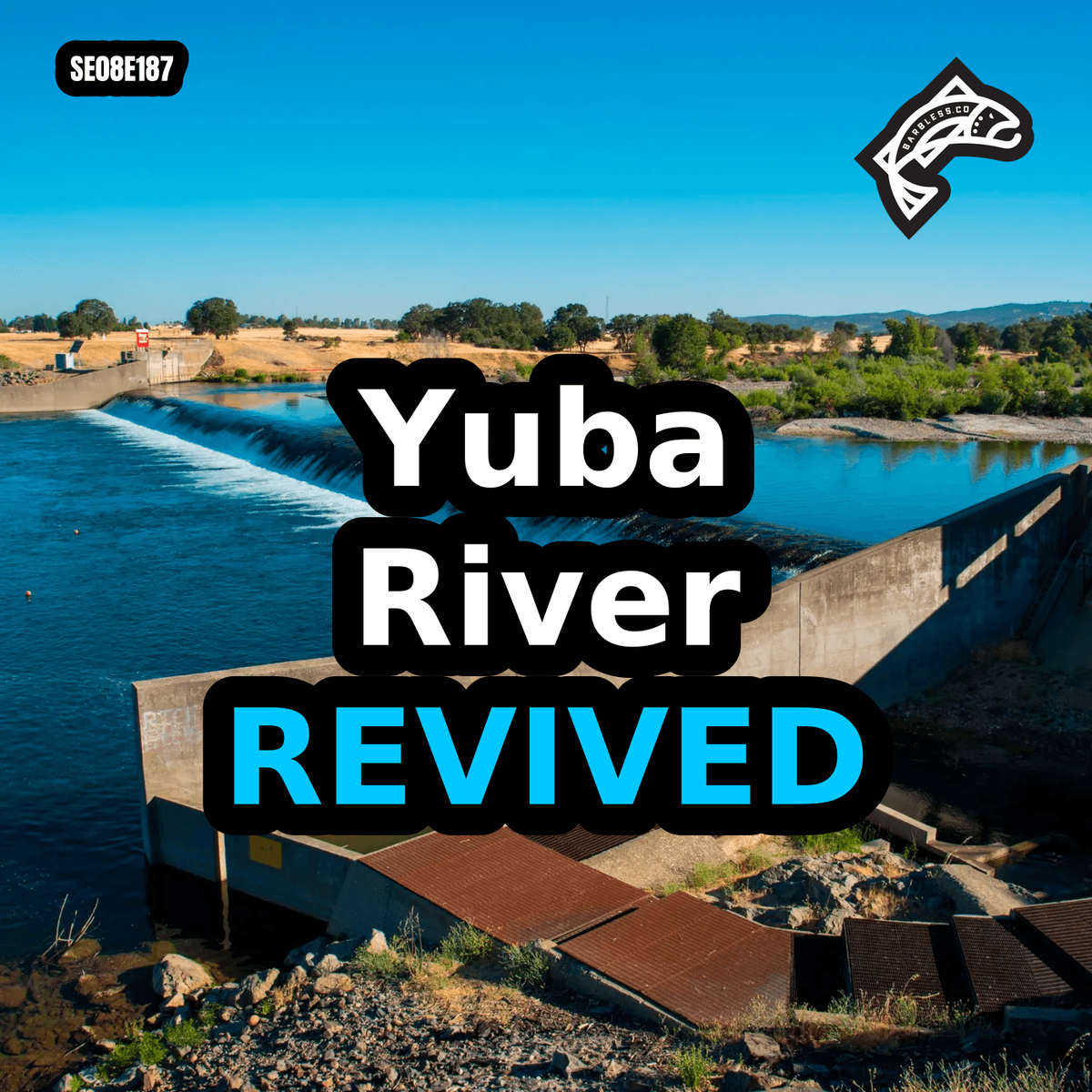
Hogan talks with longtime advocate and conservationist Frank Rinella about the proposed Nature-Like Fish Passage Project on the Lower Yuba River at Daguerre Point Dam. This project is highly controversial among Lower Yuba River anglers, guides, and community members, as it would open the stretch above Daguerre Point Dam to all fish migration—stripers, shad, green sturgeon, and, yes, more salmon and steelhead.
Hogan talks with longtime advocate and conservationist Frank Rinella about the proposed Nature-Like Fish Passage Project on the Lower Yuba River at Daguerre Point Dam. This project is highly controversial among Lower Yuba River anglers, guides, and community members, as it would open the stretch above Daguerre Point Dam to all fish migration—stripers, shad, green sturgeon, and, yes, more salmon and steelhead.
Welcome to Episode 187 of The Barbless Podcast, where host Hogan Brown dives deep into the conservation efforts on the Lower Yuba River. Joined by longtime friend and conservation advocate Frank, they discuss the intricate details of the Lower Yuba River Nature-Like Fish Passage Project and its potential impact on the local ecosystem.
"The Yuba and the waters up here have been very good to me. When I was guiding, it was a kind of payback right now." - Frank
"We're not trying to stop a project. The project has some good points to it." - Frank
"There is a resident population of stripe in the Yuba." - Frank
Episode 187 of The Barbless Podcast provides an in-depth look at the challenges and opportunities presented by the Lower Yuba River Nature-Like Fish Passage Project. Through engaging discussions with conservation expert Frank, listeners gain insight into the complexities of balancing fish passage improvements with ecological preservation. Stay informed and involved to ensure the best outcomes for these treasured waters.
Hot podcasting from Chico, California.
This is the Bartlett fly fishing podcast. Where we discuss North health fly fishing, guiding fisheries science and management,
conservation and more.
No better, fish better. Here's your host that Hogan Brian. Alright. So, hey, everybody. Welcome to the Barb podcast. My name Hogan Brown. I got a longtime friend,
practically family member, Frank
Today.
And,
Frank, before we... Before we get started here because I I had to interrupt you to hit record as you were about to give me the whole rundown, But what what is your...
I'm assuming, like, most of us, You have many official titles, but what are some of your official titles for the listeners?
Okay.
Yeah. Okay. Okay. I am the
I I do programs for California Fly fishers unlimited. Yeah. With Gold Country fly fishers, I am of the
conservation chair. And I share that with someone else, Peter Byrne.
And I've been doing that for twenty plus years, of, gold country. That's kind of my a name company.
I also do conservation with Granite Bay Fly fishers,
I'm am with the F on the education committee.
And I was a guide for almost twenty years
in the area,
the the area being
Nevada County, Hub County,
up on the,
North Hub,
and
basically, the lower you above those
since a young man and I've come up and fish the lower Yu.
Gotcha.
Yeah. And you... If I am correct me if I'm wrong, over, I would say, mean, I don't wanna say twenty years because it doesn't feel like that, but it probably been twenty years. You've really
embraced the conservation aspect of, kinda your zone.
You are absolutely right. You know, I I... I The U and the waters up here the our our whole waters shows has been very good to me. When I was guiding what I was teaching
fishing,
and it's kind of a payback right now. I've kinda in... In that thing. Right? Actually, I'm not getting out on the water as much as I should.
But it's,
yeah. And that happens. And I'd I I missed that,
but the projects that I've been able to take on because of my background.
Have been just great and been able with my background and knowing a lot of people been been able to
get people to come on for sensible reasons and back the waters shed and back our salmon.
Yeah.
And so the the the reason I wanted to have you on is I think you sent out an email a while back. And... I've kinda heard about... I've heard it called The Hub River Resilience project, the fish passage,
the
many different things. And
Right. I kinda have just had it in the back of my mind as most things that you hear about,
I guess like this that you're like, oh, yeah. That that they re... They wrote about that in the newspaper, but I probably won't be alive for it to ever happen or, you know, just
the bureaucracy of things like that take forever, changes to fisheries, dam removal, whatever. But
You sent out an email, I think a couple weeks ago that was, like, it this is happening or it's getting pretty close to happening, and I was like, man, I really I really don't know a lot about this, and I I I've started reading a lot.
And
I was like, man, you... This is a a great
person a to have on the podcast just because you and me could probably talk for hours, but I knew you would be kind of the most informed person on this.
And so
for our listeners, can you kind of explain what's happening or what is proposed to happen on the lower you, but kinda maybe
the group or, I guess, group of people you work with or represent and kinda what what's happening there?
Great. Thank you for that. Yeah. That it's my pleasure.
Let's start to beginning back in,
twenty three twenty twenty three,
Hub County Water agency. No wolf fisheries, in California
department efficient I've got together,
and they entered into a a settlement agreement where they wanted to develop a restoration project.
And this project
became known as the
a nature like fish way at the ga point tab.
And they kind of brought this out in the dark of night to us. There was no
background.
You know, I'm a a lot of committees
with circle and other
conservation groups up here, and we were really blindsided when this thing came out. And the project
as stated
is a bypass
around the gear point dam. It's stuffing more than a canal, and that's what they're calling nature like because it doesn't have any
ladder in it. It doesn't have any obstruction.
It's just a big horseshoe
that goes around their point down. And people can look that up. I'll I'll throw some pictures up, but there's there's all sorts of drawings of what this thing's supposed to look like, and it does literally look like a ditch.
Right. And let me let me put a couple things in in preference here in
First of all, En bright tab,
everything below it
is called the lower Hub river. En bright mixes the north Hub, middle Hub and South Hub altogether,
in its lake, and then reservoir.
Lets it out becomes a lower Yu. And about twelve miles down from there is the gear point down.
It's been there since nineteen o six
been blown out by numerous storms over the years.
And then in nineteen,
forty six a give or take.
They put the current day in, and they put two fish ladders in.
Gotcha the key for this whole thing is the fish ladders.
The fish ladders
over the years have kind of sorted out the fish, and they've allowed the salmon and steel head
and our wild salmon to go up into what we call sanctuary waters
above the gear point down.
And they're able to get up there and spawn and and have their
hold over time up there, free of pro predators.
And here's here's the catch.
This whole project
did never addressed
pre nation.
And what happens is this nature like fish way which is gonna be a canal or bypass
has no way of stopping stripe at bass,
which have been previously stopped at to ga point down, because stripe and actually American s
which are also a predator
do not go up fish ladders. Yeah. So this new bypass,
we we questioned that and they said they, meaning these three agencies said, oh, it's not a problem.
In reality, it is a problem. Oh, they say that things will just balance out.
But we have enough scientists on our side saying,
come on. Think about this. If you allow Stripe at bass,
into an area
that's never had strike the bass.
That's risk soon as the first one goes up there.
Gotcha.
Yeah. So that's kind of where we're at. I can go into more
detail if you'd like. Yeah. So what is... About the project. Yeah. Because I've I've read, obviously, most of the stuff online, and I'm... You know, Know. I mean, you know me as well as anyone and most people to listen know, like, I'm a huge fan of striped bass, but I'm also a huge fan of the lower U us. So, like, I kinda have tried to stay neutral on it or at least try to understand it and read the science. But
so the fear is from
your guys side that this will essentially open up that upper stretch to strike bass migration or when the stripe do move in, they'll use this fish channel
to come up and, you know, follow
follow the river up, so to say.
Correct. Correct.
And
the
the risk reward is it is this, like, a risk reward measurement because, I mean, the flip side of it is that you will probably get increased Salmon
migration. I would assume, but
can't... Is there any evidence that shows from these guys side that the fish ladders are an impediment
migration as they are now?
They may slow it down certain times of the year. Gotcha. But, you know, I've I've got a preference to be fair to the other side. And their reason for getting this up is to get also to get green sturgeon
Gotcha. Above the your point down. And that's Gotcha. One of their primary things. That is kind of the
the answer that we get from no officials. Their
their their future is to get as many of the green started up to the furthest
dam that they can. And in this case, would go in be bright. And what they're trying to do is diverse the whole
population in into different waters shares in case something catastrophic happens.
Gotcha Concern... Yeah. The concern is though that
we... Those of us who fish the lower you above the gear, know that the water is a lot colder than down below where they've come so far. Yes. And they just don't like... There's no huge pools up there for them to stay in. And when you say they, you mean the green sturgeon. With the green sturgeon.
Gotcha.
And so the... The the fish passage would open up whatever that twelve miles is to the green sturgeon because those fish are not... They're not jumping up a fish ladder. Right? Correct. They will not fill up a fish ladder. You know, we've paid...
Proposals,
we've actually had Kramer fish sciences come out and do a whole presentation. Mh.
Or the group to the management group,
stating that we could put in a,
aware that could
be removable. Yeah. And be seasonal.
And we could capture Stripe and bass,
we could let the sturgeon go around or through.
And we could
really watch what is happening. Yeah. This plan is just wide open. There's no what we call adaptive management plan for this whole process.
There's no way of they haven't done these studies to find out what the numbers of
wild trout, while Salmon, while steel had or above. So if anything happens, we have no base numbers.
Yeah. So. That's the big thing. The there's no... Hogan a sad thing is that they've done a lot of jumping through hoops, thinking they were gonna get this through. And when
the public started finding out about this and the public is circle with
Seas spa on American Rivers and Yeah. Federated of fly fishers, Nor channel guides.
And plus, you know, all of we have baby
four thousand
people signed up the stakeholders.
Yeah. That are against this process.
Yeah. Is all we're asking for is
monitor this thing,
give it a try, put a we in or some type of a device
that would slow the stripe down or stop them, give it five years. And if we need to get sturgeon up there, we all know you can truck and hall a sturgeon. Yeah. And rolling talking a few of them, and we're only talking maybe a quarter mile to get them around the dam. Yeah. From the plunge pool down below. Mh.
So
your guys is... Your guys is, I guess, platform or stance is that the fish passageway is not necessarily a bad thing. There just needs to be some mitigation of it to learn more once you put it in. Kinda idea or are you completely against building the channel? Yep. No. We're easy going on this. We really just... Whatever it takes not to allow stripe, not to allow nation. That that is it. You know, when you think about... I don't know how many people realized the the, the salmon in the lower you are wild. Same with the trout, the native trout, it is a heritage trout waters above the air point out. You know,
it's been named that through the artificial wildlife.
It's got a lot of things going for it to save
the wild salmon and the wild steel head. And now it seems like they're going against
everything that they've been trying to do, and the millions of dollars that they've done for
restoration and spawning areas up there
to help to say, but it helped to fry, And now they want to just let the stripe up.
Yeah. I would say it's a little... You know, I mean, they're even doing... I was out there the other day, and it looks like they're trying to rebuild what we would call the first island, you know, doing Yes channel over there and, like,
is
it is if you do...
There is a bit of a, like, well, would you spend all this money for in the previous? I don't know, twenty years?
But what what what do you guys have? I guess? Because I mean, I read everything they had. Right? Like, you know, Okay. There's there's...
I mean, being a stripe guy like, I do know
I am not all in on the fact that I think stripe are just gonna decimate
the wild trout population up there. I'm am smart enough to know there will be a negative impact most likely, but a couple things. Are you
You're obviously concerned about the whole waters shed. But is your
concern the effect of the wild trout population or the effect to the salmon
and steel head or just across the board letting a predator up there?
Bottom line is letting the predator up. When you think about it, and you and I both fished
the lower hub above there for years, and you had
populations back
you know, when you were in high school of twenty eight thousand or so Yeah. Thirty five thousand. It's down to three or four thousand now. Yeah. And these are but there's only two other river, one other river in in the central Valley, that still has wild fish. Yeah. We do not have supplemented
hatch fish from the or anywhere else in the U. Yeah. And we're just trying to to save that wild glass breed. Yeah.
Yeah. That that is a... That is the the valid argument to it.
What what do you guys...
You know, what do you hold up as the, like, this is the...
I guess, this is the piece of evidence that shows that this will be a negative impact. I mean, you guys, is there studies on this? I mean, outside of...
I mean, we can look at the diversion dam at Red bluff being removed
on the lower Sac and house stripe have migrated up past that through the river. I think that's probably a little different. But, like, is that the litmus test that you guys kinda use?
It is kind of... You know, on you're right. It's not it's not perfect. Yeah.
The other thing I heard they're moving the wear on the feather.
Further. Yes. Have you heard that? I have not, but it would not surprise me. Yeah. I I just heard that recently.
And so that's gonna move the stripe
population up higher.
I had heard rumbling that they were gonna take out what we call rock dam, which is the dam at Live oak. You know? Yeah. Yeah.
Yeah. Yeah.
Back to the U, I think the the big thing is
what what can we do as the public. And we just... The window just closed on,
what was called a,
a public notice.
Yeah.
Army corps
engineers. Mh. And that closed Sunday evening.
Where we had thirty days to put in our comments.
And I'll I'll preface this by saying,
the Army corps was brought into this just recently
because I don't know if it was an oversight or what this whole project
has been going along, and they re the project managers or
whoever that was doing this, realized
they don't have rights to the area around the dam that the Army corps
owns.
And you
So
what has to happen
is
department it's actually Yu county water
had to go out and get a
petition the,
army corps of engineers
for this,
I'm trying to think of the right for it. A land usage is what it is. Gotcha. Like, to build something on their property basically.
Exactly to give it over to the agents it's in the water agency. But to do that because it is government or private,
public, rather, excuse.
What has to happen is, a public Nobody has to go out. And the public notice went out to all of us, and we've answered
a lot of people answered this one. And the objections were that, you know, the Stripe and bass it also takes away from recreational use,
voters,
and other people because it doesn't seem like they want porta
around this nature like fish way.
I read on the website. The the the U county water agency said, like, there will be no recreational boating through it. So I read that as, like, you can't put a boat down it, You know? Right. We... So you can't So would they gonna them make the porta area for the tie actors and Yeah. Flow tube and everybody that goes down there normally now a real long distance. They're just feeling walk way. Yeah. It it'd be a very long walk. So the Army corps of engineers in their statements,
look at things like that. That's one of the things when they... If this this
project
starts taking away from public access. Gotcha. And but we we kind have stated that in letters.
Gotcha.
Yeah. And so do you guys have any comparable of, like, something like this, what what could happen? Or is it basically
I guess, can... I don't wanna say con
because we all as anglers prep can kinda guess what may happen. But is there any
studies? Because, I mean, I read theirs, and they use a lot of science you know, do you guys have any comparable studies of something like this and what the stripe could do in that size or river in this situation?
We have not official... Yeah. But, yes. We do. I don't have a scientific thing, but we've got a lot of papers. Yeah. And and and,
reports that just talk about
Stripe coming into an area and for the first time. Yeah. In the amount of devastation that it can put on Native fish.
Yeah.
Because I... I was reading some of the stuff that the County water agency had. And they... They... I mean, they have Peter Mo on their side who, like, I assumed would not be on their side. But
you know, You're talking
of
kind of in the in the middle kinda thing. He said he brought quite sure. If you read it closely, I was really disappointed. Yeah he what people had to say.
And then they they picked right up on that. And, put that in quotes. Yeah. They did.
But I have a lot of people that,
unfortunately, they they cannot speak up because they're with agencies. Mh. And their middle management,
And
they... It's their job. And realize like, this is not a good thing, and I can't put any names to that, but it's reality when you think about all this is Fisher and we know which Stripe do. And how many times have we caught. I've got photos of
stripe with, you know, four to six
baby sam I've in them when they... They're reg regurgitation these things.
You know, it's it's crazy.
Yeah. I mean, I guess when I look at... When I when I look at it, like, I know what has happened on the Sack. I'm I'm very
intricate involved in that just because I spend time sure out there.
And, you know, my first reaction to it is like, I don't think it's gonna be as bad if it happens as people think based on the water temperature,
you know? Because most of the cold water, the stripe that move up the sack,
basically, the only way they survive up in those cold waters is they hun down into warmer water, which is tri.
Tri mask and temperature curtains around tri.
And so, like, yeah, they're gonna wreck the trial population in the mouth of Cow Creek or, you know, something like that. But
they get up there in high water and, like, that's basically where they stay. And they're nearly impossible to get eat to eat because they don't eat that much.
You know, and I I feel like, you know, based on looking at the water temperatures, like, it's incredibly cold up there where we're talking about. Like,
I'm not sure those fish would hang out up there. You know, they're definitely gonna go up there, I think. Like, they're definitely gonna go up there. But Oh, I I totally agree with you. I don't know
I I don't know if decimate is the right word. I think they will negatively.
They're gonna eat... Be a negative impacted And I think that's a fair take middle of the road. Yeah. I kinda feel like it's not probably gonna be good, but I'd I
I don't know, like, because Peter said Peter's thing was, like, the pre dame,
the benefit to the Salmon and Seal had outweighs
what's gonna happen from the stripe.
And
I kinda, like, looking at, you know, mig times when the sm are in there, and I don't see that as the time that the stripe will be there because...
Well, I I'm been... Can I Yeah? No go. I'm I'm I'm I'm I'm I've been talking to all the the local guides and enter on board,
and the... And I'm not gonna put names to them, but
the regulars. Yeah.
There is a there is a resident
population of stripe in the Yu. There are the mig ones. They get in. Yeah. But there there is
a population that hangs below the ga point down.
In the plunge pool and down along the wing dams, Yeah. With a little fry and everybody when they're going back out, come into safe waters because they're quiet. Yeah. That's where the swipe are lurking.
And if we think about the size of the U compared to the say the sack or even the feather. Yeah. Is it's the narrow channel now. There's still hiding poses. Yeah. Oh no. I agree that change. Yeah. I I would agree. That without, you know, that was the one thing when I thought about trying to, like, use the Sack as a case study. It was like,
you know, you you're...
I always someone told me a long time ago if, you know, if you... We talked a lot about it in the drought ears on the Sack and what the stripe did to like out migrating Salmon Bowl. And stuff, and it's like, you know, the
the lions and the Gaze guitars peacefully live together on the Ser get, but, like, yes, some get eaten, you know, but everybody's population grows and thrive if you throw them all in a, you know, cage pen, the lions are gonna wreck havoc. You know, and it's kind of
the Hub is a much tighter space. Right? So there's not space for everyone to kind of find their zone. You know? So I do... That is a, like,
Okay. That could be a problem. Right? You know what I mean? Like? That is that's what a market concerns. Yeah.
And I think that's valid. I I I have a tough time
based on what I've seen the stripe do in the cold water of the upper stretches of the sack in, like,
thinking that a stripe is gonna wanna be up in fifty six fifty five degree water. You know what I mean? Like, that's just not a comfortable zone for those guys. But
you know, foods food. Right? You know? Yeah. Yeah. So... You're right? But I just been pull... While we're talking. I'm gonna pull some current temps up too. Yeah. I no. I've... I pulled some, like, averages, but, like,
It's also too, like, if you're a trout fishing guide on the lower you, but anything that's gonna negatively impact the river is a hard no. Right? Like,
I mean, I get that. Like, if I was a trout guide on the lower you, I wouldn't want this
to save my life because, hey, you're not fishing for Salmon and
stripe are probably gonna negatively impact your catch rates. So
I get it. I don't I don't think there's anything good from letting them up there. You know what I mean? No. No.
And that's what we're looking at. We're not trying to stop a project. The project
has some good points to it. Yeah the County Water
has been mandated to get a new fish screen on the south side.
Got. Right now, it's just a rock weir. So they're gonna get a thirty million dollar fish screen out of this
and they get them into compliance. Yeah.
With D and everyone else. So that's a good thing that we won't be losing
our little bolts Yeah,
into the south canal and down or... Yeah. Out Yeah. Yeah. Yeah. There's there's some pluses, but,
you know, we've gotta weigh it out. And like we said, Our base numbers for the Salmon are so low right now. Yeah.
And it's gonna be a point of no return if we start
taking picking them off.
So... There's a... You. Do we have numbers for Salmon that spawn below Dag Gary?
Yes. And I I... I've I've had the numbers and this is from the people that do the surveys. And over the years, if we broke
the U
into three segments, and that would be from Angle bright,
down to
par bar. Mh. The bridge. And park bar. Yeah. Bridge
down to the gear Okay. And then the gear
down to the mouth of the feather. Okay. They're almost all
twenty eight to thirty five percent of spawning.
It is pretty close.
Wow.
Yeah. People forget that. People think that the
ladders are as deterrent
there's only been a few times, and this is the sign that the department is taking.
But if you really check the stats
on when those ladders are closed from debris in very few days of the year.
In impact conditioner it hasn't been closed at all. Well, and it's usually... I even... I know this. I mean, it's it's usually not when those salmon are migrating up river. Right? Correct. They're opening. You know?
Yeah.
That was one of the pigs that the departments were saying, this is a reason
for this nature like fish way, it would eliminate the ladders,
which they felt was a deterrent. But if you look at the numbers,
there's an equal amount of fish that actually
go below and or stay below. Yeah sharepoint airplane down and spawned down there.
A, new project at an All.
Yes. And I... That's how I was gonna ask you is just, you know, to play like, to think about it, like, those salmon are naturally reproducing amongst sc. Like...
Yes. You know, so that's, like, it happens. It works in that waters shed.
So... But again, like,
I don't know if we have the data on how many of those out migrating sp from the lower river make it out versus the out migrating sm from the upper river. I don't know anyone out. Like, that's that's a needle and a Haystack type of data.
Yeah. The one thing about the circle put on the... Did a great job by the way, I'm putting on the a whole project along with Tiger, kind of a joint effort. Yeah. And what it was was tiered
So the fry and the sm could get up in shallower water. Yeah. And it was geared to save the fry in the salmon
besides having spawning areas.
Gotcha. So it's worked, And there's also up at rose bar
which is below the narrows.
Another project currently going on,
that they finished up this past year. They're still working on, And then you mentioned,
lawn bar. Yeah. Another project there. Those are all for the salmon.
Yeah. And it's And it it is... I mean, in my lifetime of fishing the you, but they have the salmon fry and small have lost a lot of tertiary habitat, Like, a lot of back channels and cove and all that stuff. So
Yes. Yeah. You know, it's become a tabletop in many of the areas.
The salmon red rolling salmon reds that we used to have the depressions of the fry could get down and hide at the bottom of and have the currents go over the top They're gone all around the Uc Davis property. Yes.
The old trailer area. All those are gone. Yeah. So this... It's just flat. So they could be chased
right up to the shore.
Yeah.
So... Yeah. You you guys are hoping that... Because, I mean, is this project at this point
inevitable like, is this getting built
and we're
scrambling or is there still hope? To, like, make...
I still believe there's hope this yeah. I'm gonna have to see what happens. There's some
things that they're gonna have to go through
surveys
and studies and
before they could actually finish... They want to move along. And I think this
public notice by the Army corps,
I think it's gonna set them back a little bit because they're gonna have to
answer to that. Gotcha.
That's gonna set him back for a little bit, because it was... I know sort of fact it was a lot of input. Even from our our native tribes here and Mh. Local fishermen man,
we had just regular citizens. We were
out, you know, well, basically, almost Knocking doors. Yeah. Explaining what's happening
and people
from all of the
in the auburn area,
all of the people that are out there preserving our salmon and all the ravi.
People like that go, it just doesn't make sense. Why would you want strike the bass up there. Why not do something to stop them, get some adaptive management in there to just monitor
the situation. They have no pro... No no program at all.
So if you if you don't build this, if you... Or if you... I mean, is there a way to increase Salmon returns
without doing this?
I mean, is this is this... I guess, if we build this fish passageway,
Like, obviously, in my mind, I think you're gonna probably... You're gonna see more salmon going up in there.
But
that doesn't necessarily mean there's more salmon returns because you're also looking at those those little fish gotta get out to the ocean. Right? Like... Brass correct. Like and then the gauntlet that's in the feather river with all of the the stripe down there that they have to go through. Yeah. It's unfortunate.
Mean, we know every year that they release the
the sp down on the feather.
And,
you know, you would think T
or
one of the agencies would get together with the feather River folks and the Hub River folks sit behind Bull bar and an Angle bite, and start sending some pulp slows down. Yeah. Wood date things,
and push these little guys out. And as Stripe Fishermen,
We all know that a week or so before those nets and pop pods go in with all those little fry.
The the striker are already there waiting.
Yeah. It's it's a little bit of
there... You know, I'm very pro stripe, and I'm also very pros Sam and the conflict is, like,
guys, like, you could put these fish out here at a different time or do this a little differently. Like Yeah. You're not really doing a
You're doing the stripe a disservice by making them look this bad. You know, you they they can't help himself. So smoothly or... You.
So, like, what's the... We can do this in a little smarter manner. You know? You would think someone would kinda put those two pieces together of like, hey, There's a ton of stripe in here, and we also gotta to release these salmon small. What's a good plan to do that. You know? Yeah.
It doesn't take much to do a pull slow.
Yeah. I don't know. Ties together and just push him down through the delta. Yeah.
Yeah. Yeah.
So... I do want... You want part two? Sure. Give me part two. Good cup. Do we have a moment? Oh, yeah. You're good, man.
Okay.
North Yu, rein of Salmon. Yeah. I have that on my notes to ask you about that. Like, I okay. This
this is a good, Doug. I've heard... I heard someone talking about this, and I was like, oh, my god. I can't even listen to this.
Yeah. Okay. As part of this whole plan, this is actually part of this
sixty to a hundred million dollar project.
Okay. Okay.
There... They started last year, and they put in... I think twenty five pairs some somewhere like that. Yeah. Of other river Hatch fish
into the North fork. Like, above north
You... The excuse me. Yes. Above bull,
for some of the first...
This is North hub that I'm talking about.
They put them in.
And and then at the same time, they also did these
spawning carriages with the eggs in them. Oh, yeah Yeah. Where are the eggs and stuff. And it's it's really...
The whole thing is they wanna get Salmon up to... They used to go up to historically up to Sierra City. Yeah.
Yeah. Yeah yeah. Black wind before all the dams were in. And they wanna get that to happen again.
Well, what's gonna happen is that these stamina are gonna have theirs their fry and little
finger wings, and they plan on catching
all of these with rotary screw traps
before they get into Bull bar.
So they're gonna take these fish,
which are hatch off offspring. Yeah. And they're gonna take them down to the u, they're gonna truck them down.
And they're gonna put them in above and below the gear point down. They're gonna try both places.
And these are gonna be hatch ref fish
ming with our wild fish. K.
So this year, they've increased it, and they did one hundred pair, and these are fertile fish that they plan on having them spawn up there naturally. Mh. And they the same thing. And the next spring, the
the fry and the little guys are gonna be cardio rotary screw traps and be brought down to the lower Hub again. And our concern is
are these
hatch
fish from
the feather
or they...
I don't know.
Off
mixed breed from
the lateral scuba feather?
Yeah. What what do we have that we're gonna be putting in with our wild fish?
How... I mean, I had heard that the actual collection of the fry was an absolute disaster. I think
It is. The numbers are so low. Yeah. Like... Yeah. Yeah. Like, basically B bar is gonna have land chin up now is basically what I heard. You know what I mean? Like, they totally screwed the poo on actually, like, collecting
these fish. Yeah. So like... Yeah.
You know? And that's kind of like, I think there's...
It's almost like an Oregon Washington model. They do things like that, Oregon and Washington from what I've heard. I'm... I... You know, were they truck fish above dams and truck them back to and all that type of. Right.
So apartment...
Yeah. I mean, that doesn't seem like a solution. To returning a salmon run. You know what I mean? I don't pay so either.
I think it's... There's spending so much money on this thing. Yeah.
And that's our taxpayers made that I think could go for a lot better things.
Yeah. That's Yes. But our whole started of this was
to get a few sturgeon, green sturgeon
above The get point down. That was the start, and it opened up this literally a can of worms.
For everything else that was involved
And you... Are the green sturgeon...
I... And I don't know sturgeon, but they are protected. Yes. Like, they are... There's not enough of them. Like, they need more respect. Okay.
And we... In the lower you of a occasionally, we will get
green sturgeon. They're not in there every year, but the... Actually, this year, we had probably a few more than normal, but we get green and white, and they're threatened or endangered both of them. Gotcha.
Into the... We're talking a fish that's six feet long. Yeah. Yeah. No. I mean, I see him in the sack. Guys accidentally catch them or guys fish formed during, you know, below butte city. So, like, I'm familiar with him, and I've
I've gone on that stretch below Gary, and I've seen them at times, but
it seems like a a fairly large project
to
if that is the motivation is to save the green sturgeon. Know what I mean That's a that's a big project just for green sturgeon. Not that they're not as important too. But I've never heard of any project like that in California where green sturgeon was the impetus for the project. You know?
So we haven't either. This is something new that came out of no fisheries. Yeah. And we thought, well,
why not the feather?
Yeah. Others right? Well store a lot bigger
and more volume of a river they would be
easier to get them up higher.
That rock rear and and up
into the more head waters up around that hatch.
Gotcha.
And the big... You know, the the whole big pools up there.
That that the feather has,
seems like they would be more conducive to
what I would think sturgeon would like.
Gotcha.
Now do you see if you... If we can monitor or at least So how would you... I guess, I'm trying to think of this, but how would you monitor
Stripe up river migration with this channel? Like, what does that look like?
We would look at it what... That's called the floating wear Okay. And what this weird does and and we asked that we could have
anchors put in while a thing was
being built. Mh. So we could anchor a weir in there. We brought them
conceptual
drawings and a whole program.
From Kramer fish sciences,
and this thing would have a collection basket audit it. Mh. So all of the fish coming up
would go into a collection basket. And that would be s
some of the warm water baths that come up from the where you stripe,
all of those, and they could physically sort those out. Gotcha. And that's what we're asking. Do a study, start counting how many come up.
Gotcha. Get some real numbers. Yeah. And if the numbers
don't look good, then think about that
before you open it up the the fish way to everybody.
Check it out. That's all we're asking. We weren't opposed to the project
just as a project. It's just that there's no management plan for predatory ref in it.
Yeah. And you could
I guess you could theoretically,
you know,
old school red bluff diversion damn boards, Like, put the boards in on the channel at certain times and them mop open them up at others. Right? Like, that's not... Sure. Sure. Yeah.
And that the the the two fish ladders are still there. Yeah. On air, they're not gonna... They're not gonna dispose of those.
Got. And they have a ba system
in those, and that is an kind of an infrared system that
actually can tell a stripe from a,
salmon or a steel head or a salmon. Gotcha.
Very good,
high
resolution photography in there. Where they're currently monitoring everything. So if they put a board system to stop everything
when the when they thought the stripe were coming in,
the salmon and steel had would still to use the ladders
Gotcha. That make it go up. When would when would the sense what we think? Yeah. When when would the, like, the height of the green sturgeon
migration be?
It seems to be in the spring. Okay. And I don't
that's kind of what I've heard from the local guides. Yeah.
And
we have some really good guides on the lower yu
that fish strike person and the guides up above that fish.
For the trout and stuff had.
And they've been all part of this. They've been very forthcoming there doing water temps for us. They're sending photographs to us. Yeah. Who care about the river. Yeah.
Yeah.
And so the... That's a tough one because you're gonna have the highest migration of stripe in the spring too. Right? So, like, yep. You you are... Yeah. Mark. That makes sense. Yes. That is.
And then in the spring, you may have out migration of your little sm depending on flows and things. Yeah.
Interesting. It's gonna be a mix.
Yeah. It's a bit of a gun.
Well, it's, you know, it's kinda whack them mole as you think you solve one problem and then another one pops up and you know, I I
a
pardon of me is someone who cares about all of it is, like, I don't think...
I don't think the stripe are gonna have a huge detrimental
impact, but I also have
don't know. And so am I willing to gamble the lower Hub trout beneficiary on a hunch, probably not.
You know what I mean? Like, I... Hogan good. I... Thank you for saying that. Yeah. Because that's
that there... That is a gamble that and wildlife is taking right now. Yeah. They are assuming.
There's no science on this. Yeah. They haven't known us any science. They're assuming
that that's what's gonna happen. And if it does go wrong,
they don't have a plan to fix it right now. Yeah. I mean if figure it up here. It's summer. Yeah. And I I I just don't...
I have a... I mean, I'm a stripe guy and I love stripe fishing, and I will defend stripe to the nth degree. But... Sure. Even at that point, like,
I don't think they'll stay up there based on the water temperatures and, like, the difficulty of hunting in that type of water. But at the same time,
it's a pretty big gamble to put on a hunch. You know what I mean? Like, and that's kinda
where I'm at at it is just... That's a little bit of a gamble. And It needs a gamble when you're dealing with a wild fish that cannot be replaced. Yeah. And a lot of their a lot of their data is general data. Like, I can't... You know, it's it's temperature based, fish don't feed here. They do this that. I mean, it's it's all good data. It's all true. Like, I wouldn't argue with anything that they're saying.
You know, and
I would argue with when fish move up and down that river and that type of stuff, but
I just don't... I I don't have a case study that I can
source for this and to just
gamble So you're thinking kind of that the upper ranges of the
lower eva would be what, Too cold?
Yeah. That's... Just the way that I watch the fish
move Okay. In the Sack.
I don't... The only reason you have stripe,
and this is again opinion. Right? Like, I got no scientific proof for this. But Okay. I
I believe the only reason that you have stripe that stay
in those upper stretches of the sack is that they've
they probably come up in the spring in the summer when the surface temps are warmer. But the only reason they end up staying up there is because they find those temperature curtains.
Around tri.
Right? So could be.
And
I mean, I've gone up there and fished for those fish
hours. We call we call the... Where those fish are black holes. Because you go in there and you fish for hours. You fall into the black hole. And Right. You never catch one.
Because, like, they will literally eat a sucker,
you know, a twenty four inch sucker, twenty in sucker, and then they're not gonna eat for, like, a month. Like, their metabolism slows down so much in that colder water that
they're... They just don't eat. But then you talk to the trout guys and they say, oh, well, the flats don't fish that well as they used to and a data. So
I I only have one part of the story, Right? Or one part of the
observation. Right? And I I just don't...
From what I know about Stripe behavior, they
is soon... You know, if they get into one hole up there, say they get into the big, you know, blown out damn hole, and there's ten stripe in there, like,
they'll hang out and they'll eat and they'll feed, but, like, then they're gone. Like, they're gonna leave. There's just... I don't think there's enough food up there to support them, You know, and I don't think.
I think they'll leave. You know, but that's not to say they won't eat a lot before they leave.
You know what I mean? So... Yeah. Like, I don't... I I I but again, all that said,
like, am I willing to, like, say, yeah. Go for this based on my hunch and hypothesis based on a dude that just chases Stripe like, no. No. That doesn't seem like a very... That's... I'm not wanna make that gamble.
You know?
Yeah. Could I throw a couple numbers out here? Yeah. Sure. Go for it. This is
about three weeks ago. Yeah.
Daily mean temperatures,
lower Yu.
In the En bright reach,
daily mean was fifty nine degrees
fahrenheit.
Wow. Park bar,
daily mean was sixty one.
And that's surface tank. Correct.
Well, that's wow deep this person was going. Gotcha. Yeah. That's probably, you know, the first few feet. But there again,
the hub is
how deep now? Yeah. Totally. Okay. So
the gear point down,
sixty three degrees Fahrenheit.
Down at the confluence was seventy one.
Yeah. I mean, that's plenty. Moving here to warmed up. Yeah. Yeah. And that's that's not the numbers that the hub county water agency is gonna... There's posting. Right? Like, that's not the date of their post. No. That's that's private people that are on the river fishing
have given me. Yeah.
Because sixty one is... That's go time for Stripe. They're challenge. On sixty.
Saying.
I'm gonna have a good day. If at sixty one. Horsepower bar. Yeah. Fifty diamond up at Ankle
below ankle bright. Yeah. I mean, I'm probably gonna have a good middle of the day at fifty nine, but it's sixty one and sixty three. It's go time. Oh, yeah. Yeah. So those guy's reading. Yeah. I just recently got a photograph of a stripe that was caught,
you know,
that they took a... I don't know if you've seen this around.
They took a s out of it. Oh, yeah. I catch both that. Yeah.
Yeah, With a pair of pliers, drag him out and their side by side. Oh, I... I got finish had that inning, and he took a lure or took a a streamer. Yeah. Oh, no. I've I've caught stripe with, like, multiple s tails coming out of their goal, and I kinda look out it, like, duties saw you had room for one more. Like... Exactly. It's like the, you know, the trout you catch that barf up eggs all over you. You're, like, you had room for one more. Like, this was the last one. So
no. I I I don't
Man, I I I'm pretty conflicted on it to be honest with you, but I do... I kinda side on the sense of, like,
it's probably not worth the gamble. Right? Like,
and I'm not... I...
I'd be really... You know, there's so many habitat
issues
above the dam.
It's like, unless you fix the habitat issues, It doesn't matter if you get more fish up there.
Right? Like correct. That's kind of the the double edged to this sword as you could put
more salmon up there, but if you don't correct the habitat issues then
you're not doing anything with that. So... Yeah. Yeah. The rivers has changed so much in the past we've you give.
It is flattened out,
all of the depressions of just flattened they're gone. Yeah. And I use the word tabletop earlier.
Or that's a good analogy. Like
Yeah. It is just flattened. You know, like I said earlier,
uc see Davis.
We used to walk across the top of the the reds when they... Yeah fish weren't in there, and could walk all the way across the river Yeah. And... But if we fell off, you were in four feet of water. Yeah. Yeah. Right? Drop into an elevator shaft.
Yeah. And those are no more. Yeah. So it's taken away all of that spawning, rear, hiding
Yeah.
The on the trout habitat tattoo that used to stay in there. Yeah those surprises.
Yeah. Yeah. It's it's a change River.
So
as we kinda wrap it up, what's the timetable for this project, and I guess the ability of people to, like, make their voice heard? Like, what what can people do?
You can always make your voice heard. Yeah. And this thing was supposed to have started this summer. Yeah. That's what the website say saying. And I was like, yeah. I don't think it happens. This
I don't think it has either and with this
this out grant where the
army corps jumped in saying, hey, you can't do anything. You don't own the property.
That's a pretty big oversight.
That is the big over sites. That shows you how much thought they put into this. Yeah. This was one of these things was done on a table napkin can Yeah. Late at night. They all thought, well, We can check all of boxes. We've got a bunch of funding. We can get this done. Yeah. And
the oversight were things like this, you know, predatory fish that we're gonna get up there.
But what I'd like to say in losing if I can is. Sure.
Cool country flight fishers.
In and the conservation group has taken a a need in this, for the stakeholders,
along with Granite bay fly fishers and Cf,
California fly fishers unlimited and all of the Northern
California council of fly fishers. Mh. Plus, you know, we've got people from T u and cal route and all the locals that are helping out. Yeah on our website, gold gold country
flying fishers dot org. Gotcha. If you go to the first page, people and scroll down just over it says check this out. Mh. There's a line there that says to gear point dam,
nature like Fish way, project updated.
Gotcha. Then go down below that, to go to resources.
Check on resources, and you could see all of the comments, public comments and things that
come out
in favor in talking about the whole process.
Gotcha.
Yeah.
Yeah.
The other
quick notice I'm trying to think here. We've got a good letter in that came from,
I'm trying to think California,
California advisory,
commission on Salmon and steel had drought,
wrote a letter to the director not in favor of this project.
Interesting. Because of the president, we've got them behind us.
That's
direct. It is really huge.
Yeah. They came out against this, the letter went to the director herself,
and we're following up on that.
Cool. But that that advisory commission
it was a state
entity
came out against these projects.
Which is interesting because they are all Salmon all the time. Right? Like, that's their whole goal. So if they thought this was gonna help Sam and they wouldn't worry about anything else. So... The pre foundation takes
takes over before the seven increase. It's gonna be liquidation
is
that's how we look at this. Yeah. Well, and I think the big thing is there's just no one knows. Right? It's all hypothesis at this point unless you actually start collecting some samples of fish and when when No good. Yeah.
As in as part of that,
there's three of us, there's actually a pre and post survey
sub team put together by the three agencies, the management team put it together, and they've asked us, and we have been on that. That's
Peter Burns myself, and
couple others,
we're part of that monthly group that meets and talks about this. And every time we propose something
in the way of a study it's rejected.
And there's twenty one people that work for the
agencies on this committee.
That's not.
Yeah.
Yeah. But and all, you know, but in all fairness,
these are bid management people
they cannot speak up. And, you know, they're in a rock and a hard spot. This is put in by way up on top,
the management people running these agencies. They wanna get something done
and these folks down below have just been told to get it done.
Yeah.
Well, and... Feel sorry for him. Yeah. I mean, hopefully
hopefully, there's still some time to maybe make some adjustments to the plan, and it sounds like people can still speak out you know, there'll be more meetings with the the army corps
component of this and stuff. So it's not It's not a given this is gonna happen the way they say yet. You know,
you know, common sense let's say, at least put a wear in for the five years that we're asking or three years
and just test it. Yeah. See what happens.
See what happens, you can always take a wear out.
That's why we asked this.
This portable type or types that could
transition in and out of there.
If you put the anchors in now, it just locks in.
And if you if it doesn't work, you take it out. But if it does work,
you've saved a whole population of wild fish. Yeah.
Well, great, man. I I I have I appreciate the time and we're kinda pushing up on an hour, so I try to keep it to an hour, but
that's a ton, and I I
I I look... It forced me to learn a lot about this, which is not a bad thing, and it it is...
I don't know. There's just not enough information. Right? And that's kind of the the bottom line. We. Right. Yeah.
They they need to get more information. And that's what we're asking. Yeah. And use a little common sense in this thing,
and try and save our wild fish. Yeah.
Yeah. Well, we're gonna wrap that up guys. I appreciate. Definitely, if you have questions,
gold country fly fishers dot org,
Reach out to those guys. You can get in touch with Frank there. And definitely, it sounds like a lot of resources there. You can kinda develop your own opinion. I did a basic Google search found all the stuff and
still don't really have a strong opinion. I'm kinda in the middle, but
we'll see how it shakes out. So thanks for listening, everybody, and we'll talk to you next time.
No better, fish better. Part of the Barb podcast network,
special thanks to our sponsors.
Without them, this show would not be possible.
Like this episode, leave a review.


Frank Rinella is a Northern California fly angler, former guide, and longtime advocate for the Yuba River. He spent nearly 20 years guiding the North and Lower Yuba and has devoted more than two decades to conservation work with Gold Country Fly Fishers, where he serves as conservation co-chair. Frank brings firsthand knowledge of the river to discussions about fish habitat, water management, and the future of its trout, salmon, and steelhead.
Real guides and anglers sharing practical stories, conservation wins, and lessons learned on Western waters.


Hogan Brown is a Chico, CA fly fishing guide and co-founder of the California Bass Union. He guides the Yuba, Feather, and Sacramento Rivers for trout, bass, steelhead, and carp. A fly designer and pro staff for top brands, he’s also a dad, gardener, and lifelong Giants and Notre Dame fan.


Hear real stories from guides, anglers, and innovators across the West. Unsubscribe anytime.